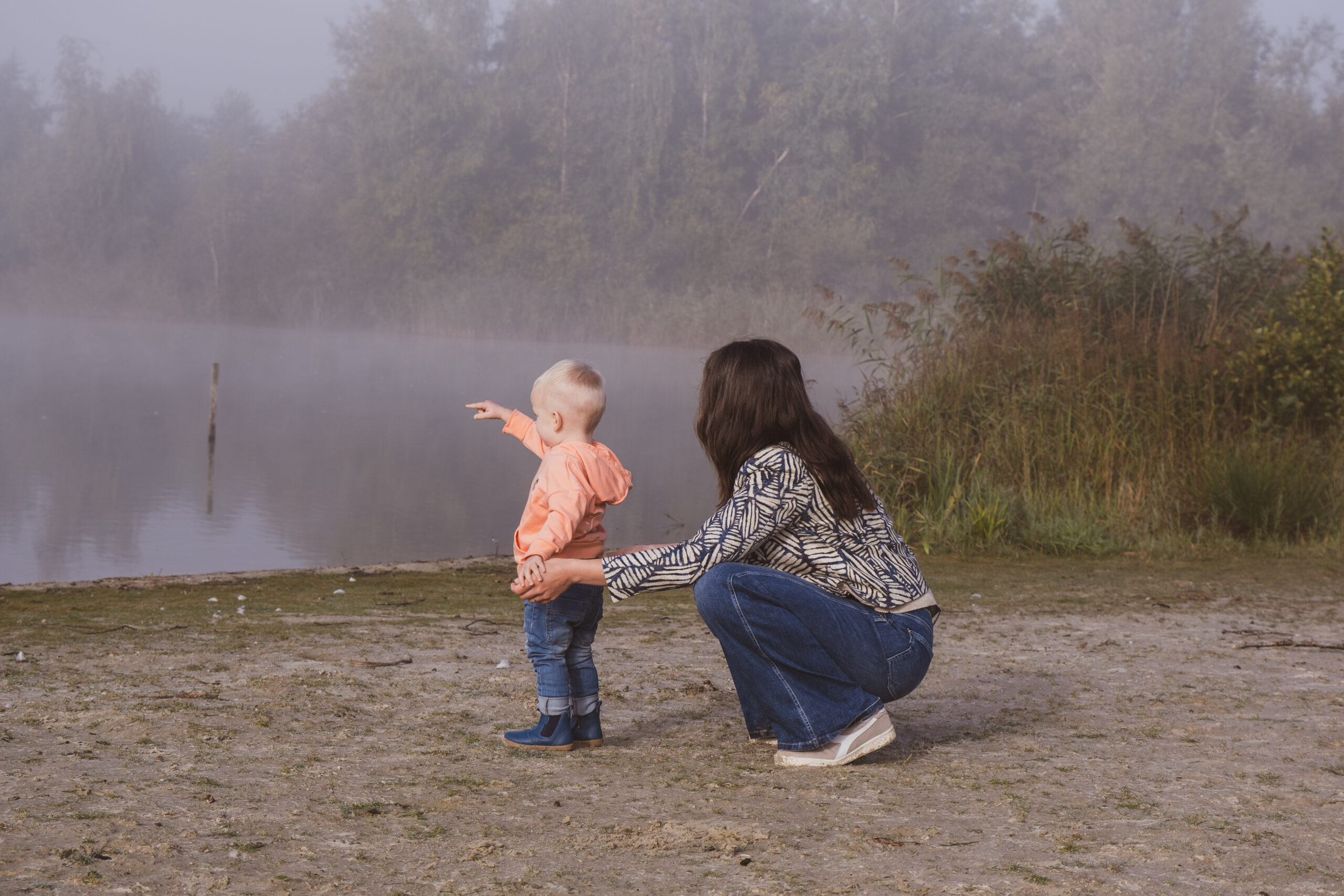
Knowledge sticks through doing. Understanding comes with doing. While a child observes the world around him, the desire to do and be able to do himself also grows. The child wants to reach for what interests him. A child wants to understand what his mother is saying. He hits and reaches for objects. He tries to make sounds that resemble his mother’s voice. Driven by internal motivation, he pushes his boundaries. Reaching becomes rolling over, sitting, crawling, and eventually walking. Crying, chirping, and babbling gradually develop into words and full sentences. In the process, he unconsciously learns to understand his mother tongue. He learns through doing that with his mother tongue he can not only communicate with his mother, but also with his father, brothers and sisters, grandmother and grandfather, uncles and aunts, other children, and adults. By learning to read and write through practice, he learns to understand his mother tongue even better. By varying movements through practice, he learns to feel how he can maintain his balance in his body and experiences how he can continually push his limits further. By making contact with himself, his social and natural environment through practice, he learns more and more about the relationship to himself, others, and the natural environment around him. By learning to understand through practice, he walks his path (Tao) in balance (Yin & Yang) and without force (Wu wei). He literally feels and experiences when he is ready for the next step and becomes the master of his own life. Because he has experienced, felt, deeply felt, lived through, and understood, he can learn to comprehend what is written about his experiences and related experiences.
But what does knowledge mean that you have never experienced, felt, lived through, and understood? As a human, are you then capable of advancing the knowledge you study? What is the value of intelligence that remains unused because knowledge remains merely knowledge instead of being transformed into wisdom? The path to development is about curiosity, seeing, hearing, smelling, feeling, doing, sharing, reflecting, trying out, evaluating, reflecting on one’s own actions and adjusting new choices accordingly, experiencing… over many years. Only then can written knowledge be the missing puzzle piece to achieve wisdom.
Trias Vita is a centre for lifelong development that supports children and young people to develop in connection with themselves, others, and the natural environment from an ecosystemic Taoist life perspective: finding your path (Tao) in balance (Yin & Yang) and without force (Wu wei).
Any questions? Mail to info@triasvita.com.
More about Trias Vita on this website.
Vicki Van Lommel, founder Trias Vita